

Table of Contents
- Why Long Lasting Mural Printing Solutions Beat Traditional Wallpaper
- How Direct-to-Wall Printing Compares to Vinyl and Wallpaper
- Material Choices That Determine Mural Lifespan
- Direct to Wall Printing Durability: What Affects How Long It Lasts
- The Bespoke Wall Mural Installation Process, Step by Step
- Commercial Wall Graphics Maintenance for High-Traffic Venues
- Cost vs Longevity: Is the Investment Worth It?
- Common Mural Failures and How to Avoid Them
- Conclusion
- Frequently Asked Questions
Last Updated: October 2, 2026
Why Long Lasting Mural Printing Solutions Beat Traditional Wallpaper
Long lasting mural printing solutions are direct-to-wall printing systems that apply UV-cured pigment straight onto brick, timber, or concrete, creating a seamless, durable finish. At Pixel Perfection, we use high-precision vertical mobile robotics to print bespoke designs directly onto walls, preserving the authentic texture of the surface beneath.
The core problem with wallpaper is adhesive failure. Paste dries out, seams lift, and in high-traffic areas the whole thing starts peeling within a couple of years. Vinyl wall wraps fare better, but they still rely on a bond that degrades with heat and humidity.
Direct-to-wall printing removes the adhesive layer entirely. The pigment cures in milliseconds under UV light, bonding to the wall surface itself rather than sitting on top of it.
Below, we explain how material choice, surface preparation, and maintenance determine how long your mural actually lasts, and where the smart money goes.
How Direct-to-Wall Printing Compares to Vinyl and Wallpaper
Direct-to-wall printing offers distinct advantages, but each method has trade-offs worth understanding before you commit.
| Method | Typical Lifespan | Surface Impact | Best For |
|---|---|---|---|
| Direct-to-wall printing | 7-10+ years | None; preserves texture | Brick, timber, concrete |
| Vinyl wall wrap | 3-5 years | Adhesive residue on removal | Smooth, temporary walls |
| Traditional wallpaper | 2-5 years | Paste damage, seam lifting | Low-traffic residential |
Vinyl’s weakness is its adhesive. In warm rooms or humid venues, the bond softens and edges curl. Wallpaper’s weakness is its seams: telegraphing seams show through within months on textured surfaces. Direct-to-wall printing has no seams to lift and no adhesive to fail.
The single biggest factor in mural lifespan is whether the print bonds to the wall or sits on top of it.
Material Choices That Determine Mural Lifespan
Ink chemistry and substrate compatibility decide how a mural ages. Three ink systems dominate commercial wall graphics, UV-cured, latex and eco-solvent, and they behave very differently depending on the surface they land on.
UV-cured pigment is jetted onto the wall and cured instantly by a UV lamp travelling with the print head. The pigment polymerises in milliseconds, forming a hard, cross-linked film that resists scratching, abrasion and most cleaning chemicals. Because there is no solvent or water carrier to evaporate, UV inks can be laid down thickly in a single pass, which is why they hold colour depth on rough brick and concrete where other systems struggle. The trade-off is that the cured film is rigid: on substrates that move, green timber, freshly plastered walls still drying out, a rigid film can crack unless a flexible primer is used first.
Latex inks use water as the carrier and cure through heat and forced air. They are low-odour and low-VOC, which makes them popular in occupied buildings, and they stretch slightly with the substrate, so they tolerate minor movement. On porous brick, however, the water carrier can wick into the surface before the pigment sets, softening edges and reducing colour density. Latex also needs a longer dwell time under the heater, which slows multi-wall jobs.
Eco-solvent inks sit between the two. They offer excellent colour depth and a slightly softer finish than UV, but the solvent carrier needs time to flash off, and the residual odour means the room usually needs to be cleared during printing. On a rapid turnaround commercial job, that drying window is often the deciding factor against them.
Surface adhesion matters as much as the ink. A glossy or sealed wall rejects most inks because there is nothing for the pigment to key into; a chalky, unprimed wall absorbs them unevenly, producing patchy colour and premature flaking. The correct sequence is almost always: clean, prime to suit the substrate, then match the ink system to that primer.
There is no single “best” ink. The right choice is dictated by the wall, not the brochure.
Direct to Wall Printing Durability: What Affects How Long It Lasts
Direct to wall printing durability depends on four variables: UV exposure, surface preparation, the environment the wall lives in, and the protective finish applied on top.
UV Inks, Surface Prep and Environmental Factors
UV inks resist fade because the pigment particles are encapsulated in a cross-linked polymer that blocks much of the ultraviolet spectrum. But no ink is immune to sustained direct sunlight. South-facing walls in bright rooms, glazed atriums and shopfronts with large windows all fade faster than shaded interior walls, because UV intensity and cumulative exposure hours are far higher.
A quote that promises the same lifespan on smooth plaster, rough concrete and a sun-facing brick wall is not telling you the whole story. Lifespan is substrate-specific and environment-specific, and any credible provider will say so.
The Bespoke Wall Mural Installation Process, Step by Step
The bespoke wall mural installation process runs in four stages: survey, surface preparation, printing, and finishing.
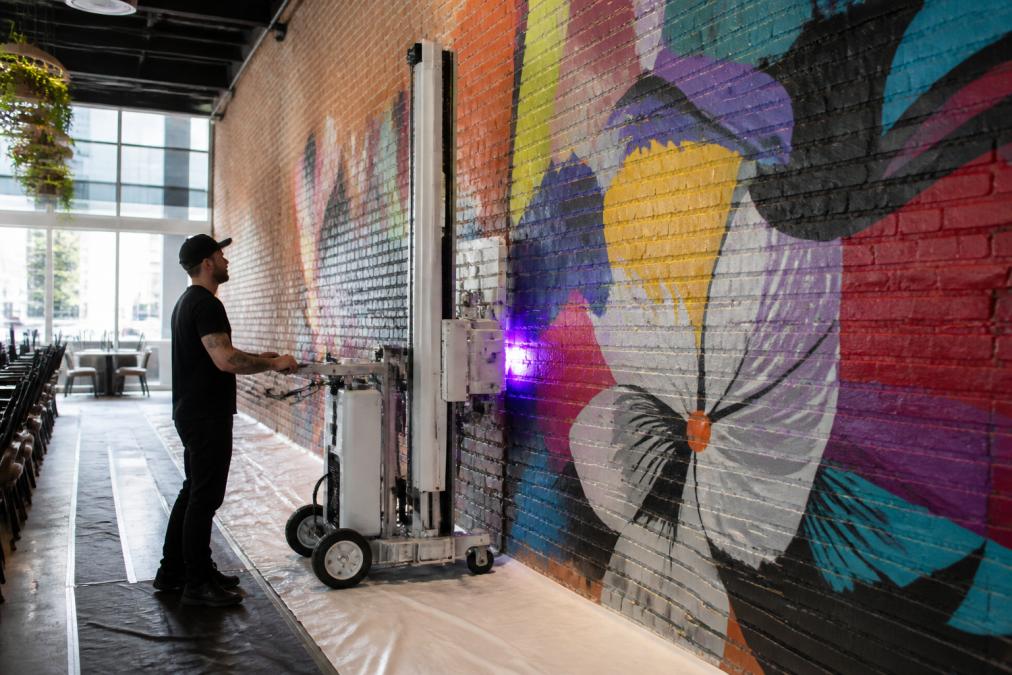
- Site survey and design upload. We photograph the wall, check texture and moisture, and confirm your bespoke design at full scale.
- Surface preparation. Cleaning, priming, and filling where needed. This stage decides how the finished mural ages.
- Direct printing. The robot prints in installation tiles, building the image section by section with no seams.
- Finishing and inspection. A protective coat goes on where the environment demands it, then a final quality check.
Surface Preparation for Brick, Timber and Concrete
Brick needs priming to fill its porous face without losing texture. Timber needs a moisture check and a bonding primer; knots and resin pockets get sealed first. Concrete, especially rough warehouse floors and walls, needs the most attention: dust removal, crack filling, and a levelling primer so the print reads cleanly across an uneven surface.
Skipping or rushing surface preparation is the most common cause of premature mural failure. Dust or moisture trapped under the print leads to bubbling and lifting that no topcoat can fix.
Commercial Wall Graphics Maintenance for High-Traffic Venues
Commercial wall graphics maintenance is simpler than most venue managers expect. A dry microfibre cloth handles routine dusting, and a mild soap solution removes fingerprints and marks without damaging the finish.
Cost vs Longevity: Is the Investment Worth It?
Direct-to-wall printing costs more upfront than a tin of emulsion, but the comparison changes once you factor in replacement cycles. Fewer redecoration cycles, no stripping costs, and no making good the wall afterwards.
Common Mural Failures and How to Avoid Them
Most mural failures trace back to preparation, not printing. Bubbling usually means moisture or dust under the surface. Fading points to UV exposure without a protective coat. Peeling at the edges, the classic vinyl problem, does not happen with direct-to-wall printing because there is no adhesive edge to lift.
Conclusion
Choosing a mural that lasts comes down to bonding method, surface preparation, and matching the finish to the environment.
Frequently Asked Questions
How long do direct-to-wall printed murals last?
Direct-to-wall printed murals typically last significantly longer than vinyl graphics or traditional wallpaper. With UV-cured inks and proper surface preparation, you can expect many years of vibrant colour, even in high-traffic commercial spaces. The exact lifespan depends on factors like wall texture, exposure to direct sunlight and how well the surface was primed. Unlike vinyl, which can start peeling within a couple of years, direct-to-wall printing bonds with the substrate itself, so there are no seams or edges to lift.
What is the difference between vinyl wall graphics and direct-to-wall printing?
Vinyl wall graphics are printed onto a separate sheet and then stuck to the wall. Over time, adhesive can fail, edges can curl and seams become visible. Direct-to-wall printing uses a vertical mobile robot to print UV-cured pigment straight onto the surface, so there is no adhesive, no seams and no risk of peeling. It also preserves the natural texture of brick, timber or concrete rather than covering it up. For long lasting mural printing solutions, direct-to-wall offers a durable choice.
Are UV-cured mural prints eco-friendly and durable?
UV-cured inks are formulated to be low in volatile organic compounds (VOCs) and are cured instantly using ultraviolet light, which means no harmful off-gassing after installation. In terms of durability, the cured ink becomes part of the wall surface, resisting scratches, fading and moisture. For businesses seeking eco-friendly and hardwearing materials, UV-cured direct-to-wall printing is a strong fit.
Can mural printing be applied to textured surfaces like brick or timber?
Yes. Direct-to-wall printing is specifically designed to handle porous and uneven surfaces such as brick, timber and concrete. The vertical robot adjusts to the wall’s contours, and the inks bond with the texture rather than sitting on top of it. This means the natural character of the wall remains visible, and the print becomes part of the architecture. Proper wall preparation, including cleaning and priming where needed, ensures the best adhesion and longevity on these surfaces.
How do you maintain and clean high-resolution wall murals?
Maintenance is straightforward. For most interior murals, a soft, dry microfibre cloth is enough to remove dust. If deeper cleaning is needed, use a damp cloth with mild soapy water and avoid abrasive cleaners or scrubbing pads. In high-traffic commercial spaces, consider a protective clear coat to add an extra layer of scratch resistance. Regular gentle cleaning, combined with keeping the mural out of direct harsh sunlight where possible, will help preserve colour vibrancy and extend the life of your bespoke wall art.
What if I want to change or remove the mural later?
One of the advantages of direct-to-wall printing is that it does not damage the underlying surface. If you decide to change the design, the process typically involves applying a primer or base coat over the existing print before printing the new design. Removal, if required, is done carefully to preserve the wall. Because there is no adhesive or vinyl to strip, there is no residue or damage to plaster, brick or timber. Costs for changes depend on the size and surface, so it is best to request a quote for your specific project.