

Table of Contents
- How Direct-to-Wall Printing Works
- Step-by-Step: The Custom Mural Installation Process
- What Affects Direct to Wall Printing Cost
- UV Wall Printing Durability and Surface Performance
- Common Mistakes to Avoid with Bespoke Wall Printing
- Why Choose a Bespoke Wall Printing Service in Sussex
- Conclusion
- Frequently Asked Questions
Last Updated: September 30, 2026
How Direct-to-Wall Printing Works
Bespoke wall printing service Sussex homeowners and business owners increasingly choose over wallpaper delivers full-colour designs straight onto the wall surface, with no paper, adhesive or panels involved. At Pixel Perfection, our vertical mobile robotics carry a print head across the wall and lay down UV-cured pigment that sets within milliseconds, so the design bonds to the surface rather than sitting on top of it.
The result is a seamless, high-resolution graphic that keeps the character of the wall underneath. Brick still looks like brick. Timber still reads as timber. The ink sits in the texture rather than masking it.
That distinction matters more than most guides admit. Wallpaper hides a surface. Direct-to-wall printing works with it.
What You Will Need Before Printing Starts
Preparation is straightforward, but skipping any of it shows in the final finish:
- A cleared wall with furniture moved back at least one metre
- A clean, dry surface free from flaking paint or loose dust
- A confirmed design file at the correct resolution for the wall dimensions
- Access to a power supply near the working area
For a commercial job, plan the print around opening hours. Most installations can be scheduled outside trading times to avoid any disruption to customers or staff.
Step-by-Step: The Custom Mural Installation Process
The custom mural installation process runs in four stages, from survey to final cure.
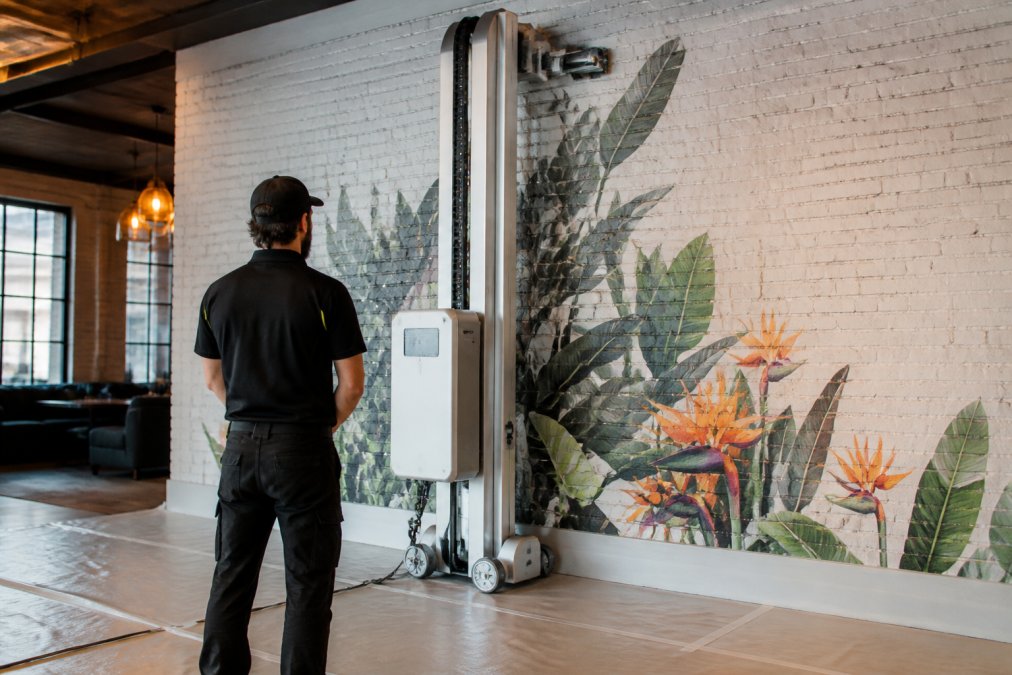
Step 1: Site survey and surface check. We assess the wall for porosity, texture and any repairs needed. Rough concrete and exposed brick are fine; crumbling plaster is not.
Step 2: Design preparation and proofing. Your artwork is scaled to the exact wall dimensions and checked for resolution. You approve a digital proof before anything touches the wall.
Step 3: Printing and Curing On Site
The robot tracks across the wall in horizontal passes, and the UV pigment cures almost instantly under the integrated lamp, which means no drying downtime and no wet ink to protect.
Step 4: Final inspection and handover. We check colour accuracy, edge definition and coverage, then walk you through aftercare.
| Stage | What Happens | Typical Duration |
|---|---|---|
| Site survey | Surface and access check | 30-60 minutes |
| Design proofing | Artwork scaled and approved | 1-3 days |
| On-site printing | Robot applies and cures design | 4-8 hours |
| Handover | Inspection and aftercare | 30 minutes |
Book the survey before you finalise your artwork. Wall dimensions and texture often change how a design needs to be scaled, and adjusting the file early costs nothing.
What Affects Direct to Wall Printing Cost
Direct to wall printing cost depends on wall size, surface condition, design complexity and access, not on a flat rate. A single accent wall in a home sits at the lower end; a multi-wall retail or hospitality scheme with intricate artwork sits higher.
The main cost drivers are:
- Total printed area. Pricing scales with square metres, not with the number of designs.
- Surface preparation. Rough concrete or previously damaged plaster may need filling or sealing first.
- Design detail. Photographic imagery and fine gradients take longer to print than bold graphics.
- Access and height. Scaffolding or extended reach adds time and setup.
- Out-of-hours scheduling. Evening or early-morning slots for retail and hospitality sites.
Compared with a decorator painting a feature wall, direct-to-wall printing offers a bespoke design that paint cannot replicate, applied without wallpaper removal, paste or mess. What you get for that is a bespoke design that paint cannot replicate, applied without wallpaper removal, paste or mess. For anyone weighing the two, the question is whether the wall is a background or a focal point.
Never accept a quote without a site survey. Providers who price from a photo alone may add charges later for surface prep or access, and the final bill can climb beyond the original figure.
UV Wall Printing Durability and Surface Performance
UV wall printing durability comes down to how the ink bonds and how the surface is treated afterwards. Because the pigment cures instantly under UV light, it forms a hard, colour-fast layer that resists fading, scuffing and moisture far better than vinyl graphics or standard wallpaper.
Vinyl decals peel because they sit on top of the wall and rely on adhesive. Printed pigment bonds into the surface itself, so there is no edge to lift and no glue to fail. On brick, timber and concrete, the design moves with the material rather than fighting it.
How long it lasts depends on the environment. Interior walls in homes and offices hold up for years with no special care. Damp-prone areas may benefit from a protective sealant. Direct sunlight will gradually soften any pigment over time, so south-facing walls may need a top coat for extra protection.
Cleaning is simple: a soft, damp cloth. Avoid abrasive cleaners and scrubbing pads, which dull the finish.
The single biggest factor in longevity is surface preparation. A well-prepped wall outlasts a poorly prepped one by a wide margin.
Common Mistakes to Avoid with Bespoke Wall Printing
The most common mistakes happen before printing starts, not during it. Getting these wrong means a reprint, a delay, or a finish that never looks right.
- Choosing a low-resolution file. Artwork pulled from a website or social media will print soft and pixelated at wall scale.
- Ignoring the texture. A design with fine detail can disappear into rough concrete or heavy brick. Bold shapes and strong contrast work better.
- Skipping the proof. Approving a design on a phone screen rarely matches how it reads at full size.
- Printing over failing plaster. If the substrate is unstable, the print will fail with it.
- Forgetting the space needs. A retail unit should be printed outside trading hours, not during them.
A common mistake is treating direct-to-wall printing like a large poster. It is closer to a permanent surface finish, and it deserves the same preparation you would give a tiled floor or a fitted kitchen.
Why Choose a Bespoke Wall Printing Service in Sussex
A bespoke wall printing service in Sussex gives you a finish that traditional decorating cannot match, without the damage and downtime of wallpaper. For hospitality venues, retail units and design-led homes, it turns an ordinary wall into the centrepiece of the room.
Pixel Perfection uses high-precision vertical mobile robotics and eco-friendly UV-cured pigment, which means no wallpaper removal, no messy cleanup and no harm to existing plaster or brick. The authentic texture of the surface is preserved, not covered.
For business owners, the appeal is practical as much as visual. There is no dust, no paste and no waste to dispose of, and the space is usable again the same day. For homeowners who have spent years getting a brick wall just right, that is the reassurance that matters most.
Conclusion
Choosing a wall finish that looks bespoke, lasts for years and leaves your surface untouched can be challenging with traditional options. Pixel Perfection removes that trade-off with high-precision vertical mobile robotics, UV-cured pigment that dries in milliseconds, and authentic texture preservation across brick, timber and concrete. Get your estimate and see how a bespoke wall printing service can transform your space without a single mark on the wall beneath.
Frequently Asked Questions
How does direct-to-wall printing work on textured surfaces?
A vertical mobile robot moves across the wall and jets UV-cured pigment directly onto the surface. On brick, timber or concrete, the printhead follows the contours closely enough to preserve the texture rather than flatten it. Because there is no paper, vinyl or adhesive, the wall keeps its original character. The ink dries in milliseconds under UV light, so there is no drying downtime and no wet-print smudging.
Is bespoke wall printing suitable for both residential and commercial spaces?
Yes. Homeowners use it for feature walls and children’s rooms, while businesses apply it to reception areas, retail interiors and hospitality venues. The same process works on plaster, brick, timber and concrete. Commercial jobs often need tighter scheduling to avoid disrupting trading hours, which is worth flagging when you request a quote. A bespoke wall printing service in Sussex can advise on the best approach for your space.
What is the typical cost breakdown for a bespoke wall printing project?
Pricing depends on wall size, surface preparation, design complexity and access. Rather than publish fixed figures, providers typically quote per project after a site survey. Ask what is included: preparation, design time, printing, curing and any protective topcoat. Request an estimate with a clear breakdown before committing.
How long does UV-cured wall printing last?
UV wall printing durability depends on the surface, location and exposure. Indoors, on a properly prepared wall, the print can last many years without peeling or fading. Vinyl graphics often fail because adhesive lifts at the edges; direct printing avoids that problem entirely. Outdoors, performance varies with weather and sunlight. Proper curing on the day is essential for long-term results.