
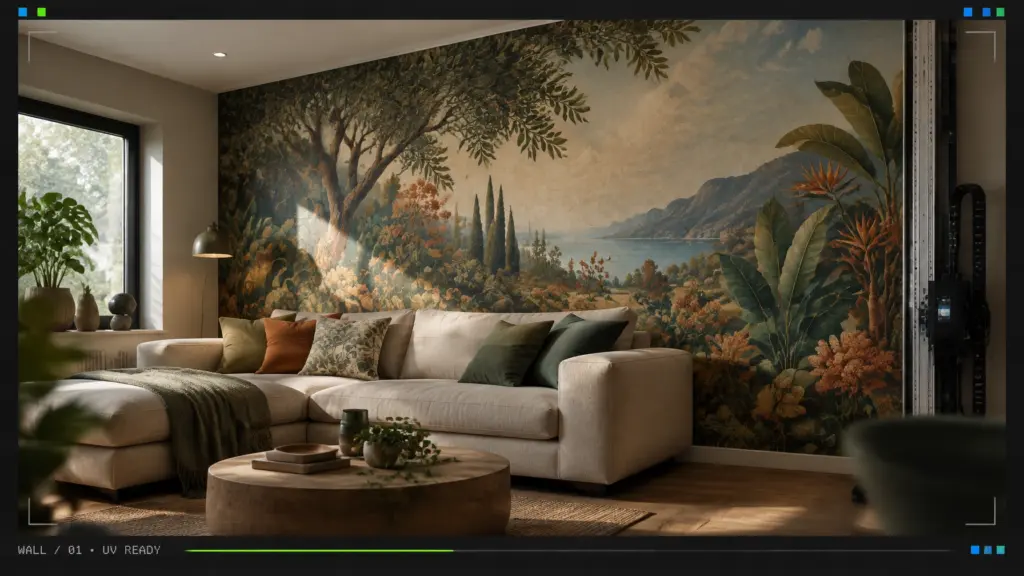
A feature wall should feel like it belongs in your living room, not like a trend that arrived after the furniture. The most enduring designs work with the room’s architecture, colours and natural focal points. They bring personality without making everything else compete.
That could mean a textured finish around the fireplace, shelving in a rich, coordinated colour, or a bespoke mural that connects your home to a landscape you love. The key is to make one clear design choice, then repeat a detail or colour elsewhere in the room.
Start with the wall the room already notices
The largest blank wall is not automatically the best one to transform. Look at where your eye goes when you enter: the fireplace, the wall behind the sofa, a built-in bookcase or a naturally framed alcove. A feature feels purposeful when it strengthens an existing focal point.
Consider the room from several angles, including the entrance and the seats where you spend most of your time. Check whether furniture, doors, shelves or a television will hide the most important part of the design. In an open-plan space, the feature wall can help define the living area, but it should not compete with the kitchen or dining zone.
Before choosing a colour or image, ask: What should this wall do? Create a calmer backdrop, add depth, frame the fireplace or bring an outdoor view into the room? A clear answer makes the design decisions easier.
1. Give the fireplace a more considered finish
A fireplace already has a natural role in the room. Make it the feature with a tactile finish, a carefully chosen colour or a wall design that draws attention to the area without overwhelming it.
Warm, earthy shades such as olive, clay and soft brown can feel inviting alongside natural wood and neutral upholstery. Limewash-style paint or subtle plaster texture adds variation, while simple tile or restrained panelling can create definition. Keep the mantel and accessories in balance with the finish: the wall should frame the fireplace, not turn it into a crowded display.

2. Choose a mural that connects with the room
A mural brings more than colour: it can set the mood and give a large wall a sense of depth. Landscapes, botanical forms and soft abstract designs can all work well, provided the scale and palette suit the space.
For a more lasting result, choose imagery that feels personal rather than tied to a short-lived motif. You might draw on a favourite landscape, a place with family significance or colours already present in the room. Repeat one or two tones in cushions, artwork or a rug, then keep the surrounding surfaces quieter.
A bespoke wall mural can be scaled to suit the dimensions of your wall, so the composition has a considered relationship with its edges, furniture and architectural features. With direct-to-wall printing, the artwork is printed onto a suitable wall surface rather than installed as joined wallpaper panels. Explore custom wall mural printing to see how a made-to-measure design can help turn a blank wall into a room-defining feature.

3. Make built-ins part of the feature
A media wall or bookcase can feel more cohesive when the wall and cabinetry are treated as one composition. Rather than giving the wall an unrelated accent colour, choose a tone that works with the shelves, joinery and furniture. You could use a single colour across the whole arrangement or combine related shades for gentle contrast.
If you want artwork behind a television, keep the image restrained. Busy detail can compete with the screen and make the wall tiring to look at. Shelving, soft lighting and a few carefully selected objects can add depth without turning the feature into a collection of distractions.

4. Add depth with simple panelling or timber
Panelling adds structure and shadow, making a plain wall more tactile. Choose a profile and spacing that suit the room’s proportions: broad, simple detailing can feel calm on a generous wall, while a smaller room may benefit from a lighter, less busy treatment.
Timber introduces warmth, but it works best when its tone relates to other finishes, such as flooring, a coffee table or shelving. You do not need to cover every wall. A carefully framed area around a fireplace or seating zone can be enough.
The longer-lasting choice is usually the one that complements the home’s existing architecture, rather than copying a distinctive panel style simply because it is popular now.
5. Try colour without creating a hard contrast
A feature wall does not have to be the darkest or brightest wall in the room. Tonal colour can add character more subtly: choose a shade already found in the rug or artwork, then use a lighter or deeper version on the wall.
You might also extend the colour onto a nearby alcove, trim or built-in unit. This helps the feature feel integrated instead of appearing as an isolated rectangle. For a stronger effect, richer shades such as smoky teal, olive or rust can bring warmth and depth; use them where the daylight, furnishings and room size can support them.
Paint samples are useful, but check them at different times of day. Natural light and warm lamps can change how a colour reads. A shade that feels balanced in daylight may look quite different in the evening.
6. Turn an alcove or bookcase into a contained feature
A smaller area can be a better place for visual interest than a whole wall. The back of a bookcase, a recess beside the fireplace or a shallow alcove can take a different colour, a subtle pattern or a small-scale mural.
This approach helps define an awkward space without adding visual weight everywhere. It is also useful when the main walls are already occupied by windows, artwork or furniture. Keep the design aligned with the room: a colour repeated in accessories, or a motif that echoes the wider scheme, makes the feature feel connected.
7. Let artwork lead the design
A large piece of art, or a thoughtfully arranged gallery wall, can be the feature in its own right. This gives you a flexible way to express your style without committing to a permanent wall treatment. It also makes updating the room simpler: change the artwork, and the focal point changes with it.
For a more integrated look, you can take inspiration from a favourite artwork when choosing paint colours or a custom wall design. The important thing is to give the piece room to breathe. Avoid placing it against a competing pattern or surrounding it with too many other focal points.
A quick checklist for a feature that feels at home
Before you settle on an idea, check that it works with the whole room, not just in a cropped inspiration photo.
- Placement: Does the wall have a natural role in the layout?
- Scale: Will furniture or fittings obscure the main details?
- Palette: Does the feature relate to colours already in the room?
- Light: How will the finish look in daylight and after dark?
- Balance: Will the rest of the room give it space to stand out?
- Surface: Is the wall clean, sound and suitable for the finish you have in mind?
The principle is simple: choose a focal point, select a finish that suits it, then repeat a colour or detail elsewhere. That gives the room cohesion without making every surface compete for attention.
Make the blank wall feel like yours
A living-room feature wall does not need to follow a trend to make an impact. It needs to fit your home, your furniture and the way you want the room to feel. A textured fireplace wall, coordinated built-ins or a bespoke mural can all create a distinctive result when the design is planned around the space.
Pixel Perfection provides direct-to-wall printing for residential interiors across West Sussex and Sussex. Artwork is digitally prepared and scaled to the wall, then printed directly onto a suitable surface using UV-curing inks. The service is mobile, fully insured and designed to bring a custom idea from concept to finished wall.
For more inspiration, read our guide to direct-to-wall printing for residential spaces. If you have a wall in mind, share your idea with Pixel Perfection, whether it is a finished design or simply a colour, mood or image you would like to explore.