
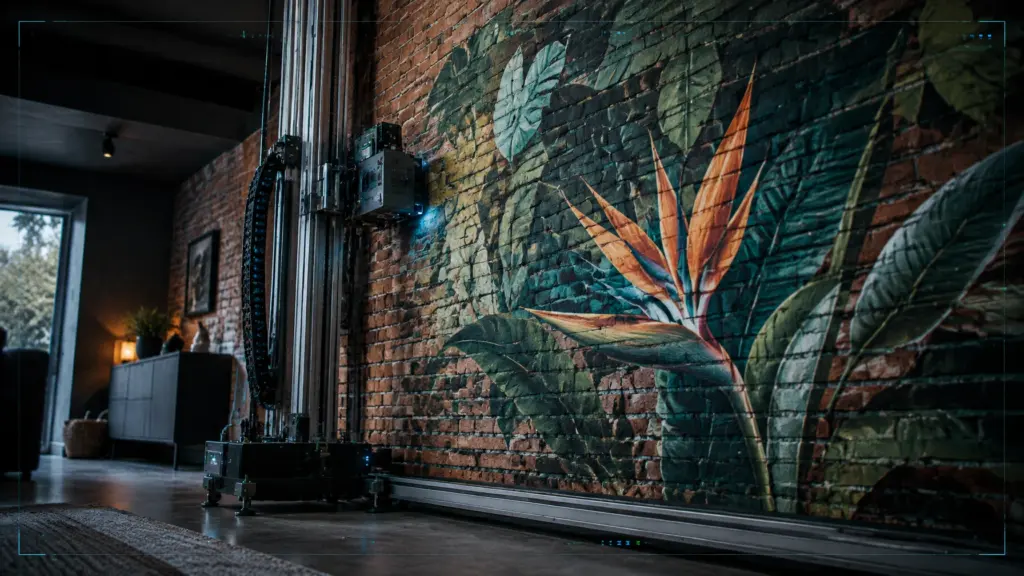
Brick has character built in: warm colour, crisp edges, visible grain. With direct-to-wall printing, you can add a bespoke mural or graphic without hiding that texture beneath wallpaper. The printer applies the artwork straight onto a suitable wall, so there are no paper panels, paste or wallpaper seams.
The key is preparation. Brick varies from wall to wall, and the surface beneath the artwork matters as much as the design. Here’s what to check before planning a brick wall print for your home.
1. Check that the brick is ready
A wall needs to be sound, clean and dry before printing. Start by looking closely at the brick faces and the mortar joints.
Check for:
- Crumbling or loose brick and mortar
- Damp patches, mould or salt deposits
- Flaking paint or dusty, powdery surfaces
- Cracks, loose render or evidence of water getting in
- Deep recesses or uneven areas that may affect the print
Printing does not fix a damaged wall. If you find a problem, address it first and ask a suitable professional for advice where needed. A site assessment can help establish whether the surface is suitable and what preparation it needs.

2. Clean gently and let the wall dry
Dust, cobwebs and loose particles can interfere with a consistent finish. Brush or vacuum them away, including from the mortar joints. If the brick is greasy or has other marks, use an appropriate cleaning method for that surface and allow it to dry fully before printing.
Avoid aggressive cleaning, especially on older or historic masonry. Brickwork can be more delicate than it looks, and harsh treatment may damage its surface. If you are unsure how to clean it safely, get advice before proceeding.
A dry wall is essential. Do not print over an unresolved damp problem: the cause needs attention first. The printed design is not a damp-proofing treatment.
3. Understand how the texture affects the result
Direct-to-wall printing follows the wall; it does not smooth it. The raised faces and recessed mortar joints remain visible, so the finished artwork keeps some of the brick’s natural character.
That texture can be part of the appeal. It can make a graphic feel integrated into a games room, snug or feature wall rather than applied as a separate layer. But it also affects detail. Very fine lines, tiny text and delicate gradients may look less crisp across deep joints or pronounced bumps.
Bold shapes, clear contrast and larger details are often a good fit. Before finalising the artwork, consider where the mortar lines fall and whether they cross important parts of the design.

4. Choose artwork that suits your wall
A brick wall can carry a family photograph, a custom illustration, a striking colour field or a brand-inspired design. The best result starts with artwork that suits both the room and the surface.
Think about:
- Viewing distance: Will people see the image from across the room or close up?
- Lighting: Daylight and room lighting can change how colours appear.
- Wall features: Plan around sockets, alcoves, shelves and adjoining walls.
- Image quality: Use the highest-resolution artwork available, especially for large images.
- Scale: Position important details where the brick surface is most even.
Pixel Perfection can prepare and scale artwork to the wall’s measurements. That helps you understand the layout before printing starts. For more inspiration, explore our guide to direct-to-wall printing for residential spaces.
5. Arrange a test and confirm the surface plan
Brick is porous, and different bricks can take ink differently. Colour and sharpness may vary depending on the wall’s surface, its existing finish and the artwork. A representative test patch is a practical way to check how the print looks on your actual brick before committing to a full design.
If the wall is painted, confirm that the paint is firmly bonded and not flaking or chalky. If it is bare or unusually absorbent, ask the printing professional how that may affect the result. A coating or primer should not be applied automatically: on some older walls, it could change the appearance or affect the wall’s ability to breathe. Any proposed treatment should be appropriate for the masonry and compatible with the printing system.
Also ask how the machine handles the wall’s contours. Printers have limits, and these vary by equipment. A site visit helps identify uneven sections, access issues and any areas that may need attention before the work begins.
6. Get the area ready for printing
Once the wall and artwork are agreed, prepare the room for the installation. Clear furniture away from the work area, remove items from the wall and make sure the printer can be positioned securely. Discuss any delicate flooring or nearby fixtures in advance so they can be protected.
The operator will position the machine and print the design directly onto the prepared surface. Pixel Perfection uses UV-curable inks that cure as they are printed, so the finish is ready without a long drying period. The inks are odourless and non-toxic, making them suitable for indoor environments.

Is every brick wall suitable?
No. A sound, dry brick wall with a stable surface is a much better candidate than one that is damp, crumbling or severely uneven. A professional assessment is particularly important if the brick has been painted, repaired, sealed or treated with an unknown product.
If you are considering an external wall, remember that outdoor exposure brings extra factors such as rain, frost and sunlight. Ask specifically about the suitability of the wall, the printing system and the expected performance outdoors.
Historic or listed buildings need additional care. In England, listed building consent may be required for work that affects a listed building’s special character, including some changes described as decoration. Check with your local planning authority before altering historic masonry. The Planning Portal’s guidance on internal decoration is a useful starting point, but it is not a substitute for advice about a specific listed property.
Brick printing or wallpaper?
Wallpaper covers the wall with material. Direct-to-wall printing puts the design on the surface itself. That means no wallpaper panels or paste, and the brick texture stays visible through the artwork.
The right choice depends on the wall and the finish you want. Wallpaper may suit a smooth surface or a design you want to remove later. Direct printing is worth considering when you want a bespoke image on suitable brick without disguising its character. Read our comparison of direct-to-wall printing and wallpaper for a closer look at the differences.
Turn a brick wall into a feature
The process is straightforward: inspect the wall, clean it, choose artwork that works with its texture, and confirm the surface with a professional before printing. With the right preparation, a plain stretch of brick can become a distinctive feature while retaining the detail that makes it unique.
Pixel Perfection provides bespoke direct-to-wall printing across West Sussex and Sussex, with mobile equipment, high-resolution artwork preparation and fully insured service. If you have a brick wall in mind, share your idea and request an estimate.