

Top 7 Custom Wall Mural Printing Picks for 2026
A homeowner in West Sussex tapes three life-size printouts to a freshly painted wall, then steps back until her heels touch the skirting board. At 3:40 pm, the room changes. One image that looked brilliant at breakfast goes muddy in the afternoon light, another crashes into the radiator line, and the quietest design suddenly wins.
That is how most smart custom wall mural decisions actually start — not with trend boards, but with a real wall, real light, and real compromises. You are not only choosing artwork. You are choosing how that artwork behaves in a terrace in Worthing, a salon in Chichester, or a meeting room in Crawley.
This guide is for homeowners, landlords, retailers, and workplace teams across Sussex who want a shortlist they can act on quickly. I would judge every mural option the same way: by wall fit, durability, cleanability, install effort, and whether it still makes sense six months after the photos are taken.
Selection criteria: what makes a mural option worth recommending in 2026
Wall condition and surface prep
Pretty artwork is easy. Good fit is harder.
Smooth, clean, primed walls give the best result for most mural applications. If your wall has flaky paint, chalky plaster, damp patches, or deep orange-peel texture, the fanciest image in the world will still struggle. I have seen thin adhesive panels look perfect on a sample board and then lift at the edges on a dusty hallway wall in Hove within days.
Start by being blunt about the surface you actually have. On a smooth painted plaster wall, most options stay on the table. On rough render, patched old masonry, or newly repaired surfaces, your shortlist narrows fast.
Durability, cleanability, and lifespan
High-traffic areas need tougher, wipeable finishes than low-use feature walls. A bedroom mural in Arundel can lean softer and more decorative. A corridor outside a treatment room in Horsham cannot. Bags brush it. Hands touch it. Cleaning staff wipe it down.
Ask one simple question before you choose a finish: what will this wall need to survive? Fingerprints, chair knocks, steam, sunlight, or just being looked at? If the answer includes daily contact, skip delicate materials unless you are happy to baby them.
Room type, lighting, and intended use
Lighting changes everything. A south-facing room in Littlehampton will read a mural very differently at 9 am and 4 pm, and glossy finishes can throw reflections exactly where you do not want them. Large murals also need to be supplied at high resolution so the image stays sharp at full wall scale — especially when you are spanning a 2.4-metre wall and want details to hold up from both the doorway and the sofa.
Function matters just as much as appearance. A quiet therapy room, a branded reception backdrop, and a children’s playroom all ask for different things from the same wall. Choose for the job first. Style gets easier after that.
The best mural choice is the one that matches the wall you have, not the wall you wish you had.
| Option | Removal | Durability | Finish Feel | Best Fit |
|---|---|---|---|---|
| Peel-and-stick removable | High | Light to medium | Smooth, simple | Rentals, quick refreshes |
| Wallpaper-style printed | Low to medium | Medium | Decorative, seamless | Feature walls |
| Heavy-duty vinyl | Low | High | Wipe-clean, tougher | Busy interiors |
| Fabric mural | Medium | Medium | Soft, matte, premium | Bedrooms, lounges, reception |
| Acoustic fabric mural | Medium | Medium | Soft, sound-calming | Meeting rooms, quiet spaces |
| Exterior-grade mural | Low | High | Weatherproof statement | Shopfronts, outdoor branding |
| Hand-finished bespoke | Low | Varies by system | One-off, artistic | Hero walls, premium interiors |
If speed, flexibility, and simple replacement matter most, start with the next three. They suit the kind of jobs Sussex readers often want done quickly — a Brighton rental, a family snug in Haywards Heath, or a short-notice retail refresh before a launch weekend.
For rented or short-term spaces, removability is a feature, not a compromise.
#1 Peel-and-Stick Removable Mural
This is the easiest entry point for most homes. You get a self-adhesive mural designed for easier removal than a permanent pasted system, which makes it a strong first stop when commitment is the real question.
What you get
Peel-and-stick murals work best on smooth painted walls and are popular because they are easier to handle, easier to swap out, and less messy than paste-based installs. For a nursery in Shoreham or a home office in Lewes, that flexibility matters. You can refresh the room without treating the wall like a forever decision.
Where it struggles
It is less forgiving on dusty paint, textured plaster, and humid rooms. Deep texture can break contact. Cheap emulsion can come away with the adhesive. Steam from a bathroom or regular heat from a radiator can also shorten its life. Wide panels demand patience — even a few millimetres off at the top can travel fast by the time you reach the skirting.
Best for
- Rental homes and short-term lets
- Children’s rooms and home offices likely to change in 1-3 years
- People who want a DIY-friendly first project on a smooth wall
#2 Wallpaper-Style Printed Mural
If you want a classic full-wall decorative finish, this is often the sweet spot. It feels more permanent than peel-and-stick and usually gives a calmer, more integrated look across a large interior wall.
What you get
Wallpaper-style murals work well on big feature walls where the goal is a seamless decorative statement rather than a temporary experiment. In a main bedroom in Chichester or a stair wall in Petworth, this type often looks more settled and architectural. It reads less like a panel and more like part of the room.
Where it struggles
The trade-off is commitment. Removal is not as easy, and installation is less forgiving if you rush the joins or ignore wall prep. You also need to think ahead about corners, sockets, and trims before anything is printed or cut. If the wall has awkward returns or visible settlement cracks, a decorator with mural experience earns their fee quickly.
Best for
- Homeowners who want a long-lasting feature wall
- Bedrooms, hallways, and living rooms where softness matters more than scrub resistance
- Decorative interiors aiming for a built-in rather than temporary look
#3 Heavy-Duty Vinyl Mural

This is the practical workhorse of the list. When your wall will be touched, cleaned, and bumped, vinyl earns its place fast.
What you get
Vinyl mural applications are typically chosen for wipe-clean durability and better resistance to everyday scuffs. That makes them useful in family kitchens, retail corridors, café seating areas, and treatment rooms across Sussex. Colour also tends to look bold and confident, which helps when the mural has a branding job to do as well as a decorative one.
Where it struggles
It can feel more commercial than fabric or paper, especially if the finish throws a little sheen under strong spotlights. Thick material also demands careful handling around internal corners and switch plates. In a quiet reading room or soft-toned bedroom, vinyl can look slightly too hard-edged unless the artwork and lighting are chosen carefully.
Best for
- High-use interiors that need wipeable durability
- Commercial walls in salons, clinics, cafés, and schools
- Homes with children, pets, or a lot of daily contact
When the mural needs to look richer up close and feel softer in the room, shift your attention to fabric-based finishes. These are the options I would shortlist for lounges, bedrooms, and quieter commercial interiors where the atmosphere matters as much as the image.
A room can feel more expensive when it sounds calmer, even before the furniture changes.
#4 Fabric Mural
Fabric murals are about texture and restraint. They often look better the longer you stand near them.
What you get
Fabric mural finishes create a softer, textile-like look than glossy printed films. They absorb light more gently, which helps artwork feel calmer and more premium in person. In a bedroom in Midhurst or a reception area in Horsham, that softer surface can be the difference between a wall that shouts and one that settles the whole room.
Where it struggles
Fabric is not the first choice for greasy kitchens, splash zones, or walls that need frequent scrubbing. It also asks for cleaner handling during install, since marks and edge damage show up faster than they do on tougher vinyl. Price can be higher too, especially when you want an especially refined matte finish.
Best for
- Lounges, bedrooms, and reception spaces
- Feature walls where close-up texture matters
- Interiors chasing a warmer, quieter visual feel
#5 Acoustic Fabric Mural
This is the most underestimated option on the list. It improves the room twice — first with imagery, then with sound.
What you get
Acoustic-backed fabric options can help reduce echo in furnished interiors, which is a bigger quality upgrade than many buyers expect. In a meeting room in Crawley, a therapy space in Hove, or a restaurant booth wall in Brighton, calmer sound makes the entire room feel more composed. You notice it when voices stop bouncing.
Where it struggles
These systems are usually thicker, more technical, and less casual to install than a simple printed roll. You need to think about depth, edge detailing, and the way the mural meets sockets, joinery, or glazing. They are also less suited to walls that need constant hard wiping.
Best for
- Meeting rooms, home cinemas, and quiet lounges
- Reception areas where you want both softness and polish
- Commercial interiors where echo control helps the space work better
Now for the statement choices. These come into play when the mural must survive weather, carry branding, or feel unmistakably bespoke up close.
Outside, durability comes first; up close, the finishing touches decide whether it feels premium.
#6 Exterior-Grade Mural
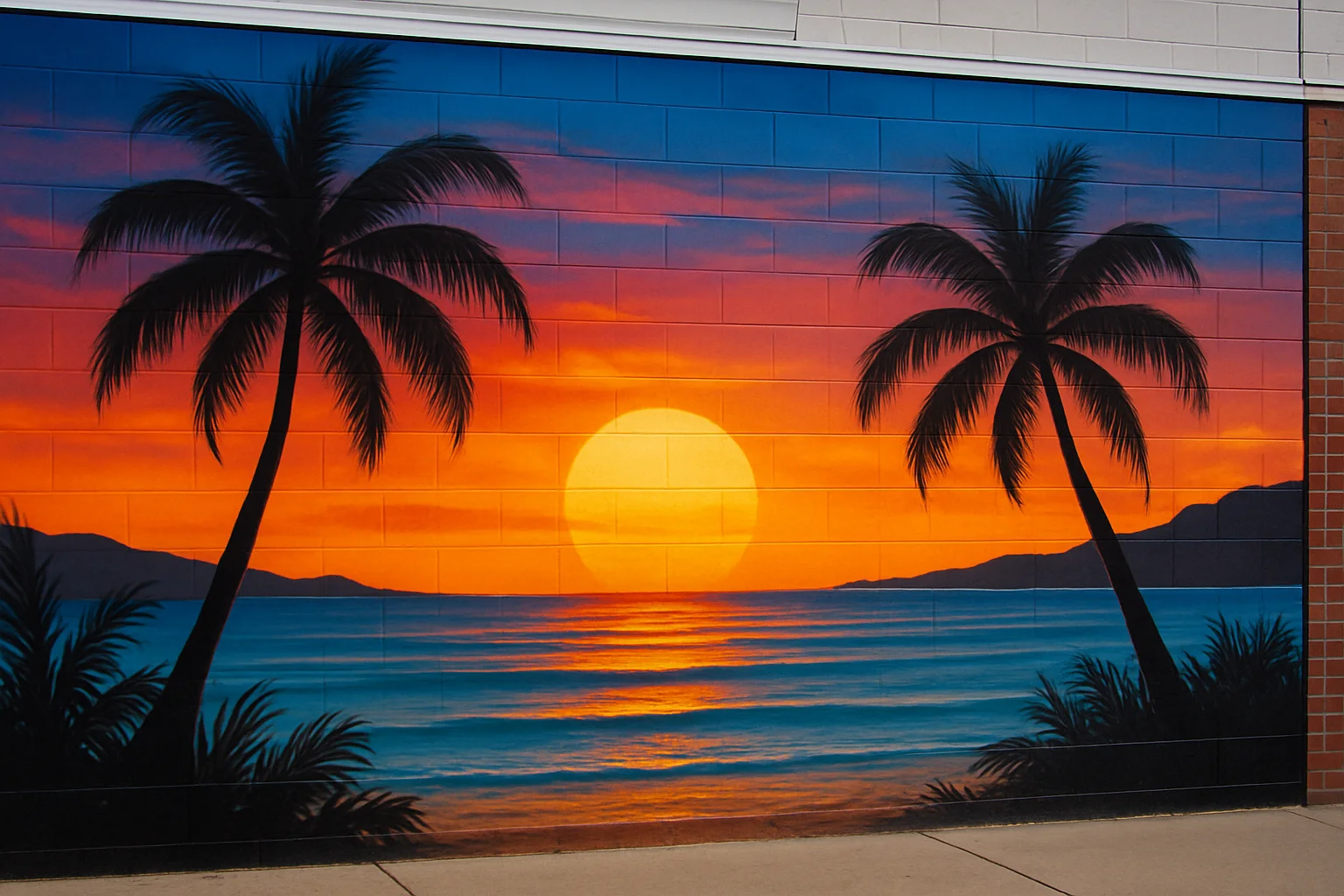
This is a different discipline from interior decoration. A mural outdoors has to perform before it impresses.
What you get
Exterior murals need UV-resistant materials and weatherproof construction to handle sun and moisture exposure. For a shopfront in Worthing, a courtyard wall in Arundel, or a school entrance in Bognor Regis, that means choosing a system built for rain, heat, and wall movement rather than just good colour on day one.
Where it struggles
Outside, weak prep shows up fast. Cracked render, unstable paint, or damp behind the surface will shorten the life of the job no matter how good the artwork is. External installations may also need permission in some settings, especially where building rules or signage rules apply. If you are near a conservation area or a managed retail frontage, check before you proceed.
Best for
- Shopfronts, shutters, courtyards, and branded outdoor walls
- Public-facing graphics that need weather resilience
- Projects where visibility matters as much as decoration
#7 Hand-Finished Bespoke Mural
If you want the mural to feel genuinely one-of-a-kind, this is the premium end of the shortlist. It combines printed imagery with painted or artistic detailing for a less repeatable result.
What you get
Hand-finished murals can combine printed imagery with painted detailing, metallic accents, edging work, or site-specific touch-ups. That matters when the wall has awkward architecture or when the design needs to feel less manufactured. In a hospitality space in Brighton Lanes or a reception feature wall in Gatwick-side offices, those final touches often decide whether the mural feels merely large or actually special.
Where it struggles
You pay for time, skill, and coordination. Lead times are usually longer. Revisions can be slower. You also need clarity early, because bespoke work becomes expensive when the brief keeps shifting after production starts.
Best for
- Luxury homes, boutique hospitality, and hero brand walls
- Projects where close-up finish matters as much as scale
- Clients who want a mural that does not feel off-the-shelf
How to choose the right custom wall mural option
Your shortlist should shrink quickly once you answer three questions: what is the wall like, what will touch it, and who is installing it? If you answer those honestly, you usually end up with two sensible options instead of seven tempting ones.
Match the mural to the wall condition
Start with the substrate, not the artwork. Smooth painted plaster opens the door to peel-and-stick, wallpaper-style, vinyl, fabric, and other bespoke interior systems. Rough texture, patched plaster, or old paint closes several of those doors straight away. Large murals are also easier to install cleanly when corners, sockets, and trim are planned before production. Measure the full width, height, recesses, and socket positions before anyone finalises panels.
If you want a seamless interior result without overlapping joins, a well-planned bespoke wall system can be worth comparing with panel-based approaches — especially on well-prepared walls where accuracy and clean installation matter.
Match the finish to traffic and maintenance
A decorative feature wall in a bedroom can prioritise softness, texture, and mood. A busy commercial corridor should prioritise wipeability and impact resistance. High-traffic commercial areas usually benefit from more durable, wipeable materials than decorative residential feature walls, which is why heavy-duty options keep showing up in practical fit-outs from Horsham to Worthing.
Think through the maintenance routine now, not later. If your cleaner uses regular surface wipes, choose something that welcomes them. If the mural will sit behind a sofa and never be touched, you can afford to choose for atmosphere.
Decide whether you need DIY-friendly or professionally installed
Peel-and-stick is the most approachable for capable DIY work on a plain wall. After that, difficulty rises fast. Wallpaper-style murals, vinyl, acoustic systems, tall stairwells, and anything with tight alignment usually benefit from professional installation. Professional help is often worth it for tall walls, awkward joins, and branded spaces where alignment matters — especially when one crooked seam would be visible from the front door.
If you are comparing quotes, ask whether design scaling, test placement, wall prep advice, and calibration are included. Those details decide whether the install feels calm on the day or turns into three hours of trimming around sockets in a rush.
If you are unsure, choose by lifespan first and style second.
| Your Situation | Start With | Why |
|---|---|---|
| Brighton rental flat, smooth painted wall | Peel-and-stick removable mural | Easy swap-out and lower commitment |
| Main bedroom feature wall in Chichester | Wallpaper-style or fabric mural | Softer, more settled decorative finish |
| Busy café or salon in Worthing | Heavy-duty vinyl mural | Better scuff resistance and wipe-clean care |
| Meeting room with echo in Crawley | Acoustic fabric mural | Improves sound as well as appearance |
| Outdoor branded wall or shopfront | Exterior-grade mural | Handles UV, moisture, and public exposure |
| Hero wall for premium hospitality or brand space | Hand-finished bespoke mural | Most distinctive close-up result |
The right mural wins on fit, not fashion.
That is the real promise of custom wall mural planning: match the material to the wall, the room, and the years you expect it to work, and the design starts doing its job every day.
Before you choose the image, what does that wall actually need to survive — fingerprints, sunlight, echoes, weather, or a full brand refresh?
Bring Sussex Spaces to Life with Pixelperfection
Pixelperfection creates bespoke digital experiences for Sussex businesses, with precision UI, secure architecture, and high-performance web applications tailored to your needs.
Generated on SEOPro AI